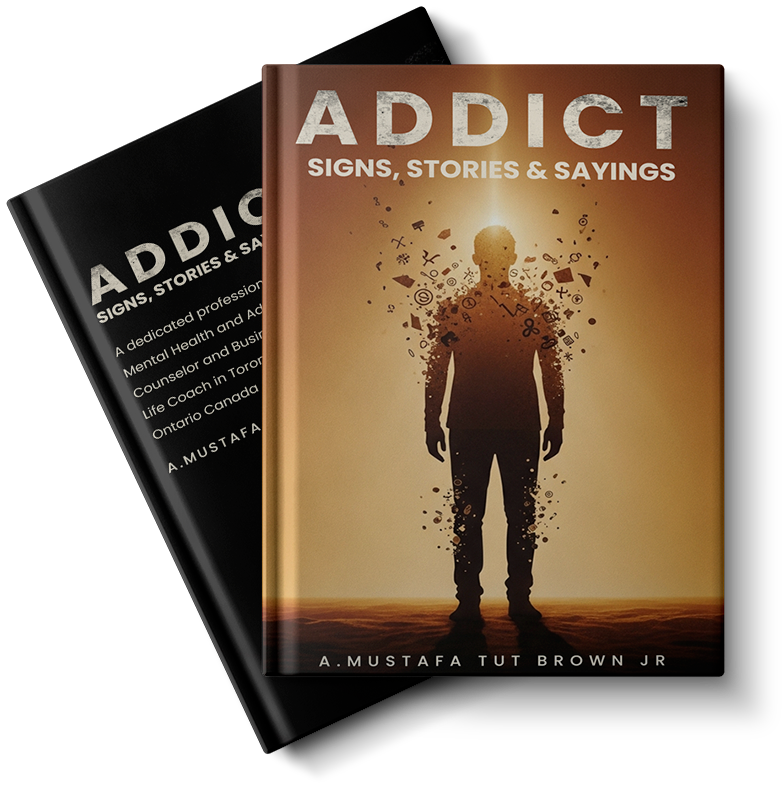
In today’s fast-moving world, people often overlook the subtle signals that shape their lives. Whether in business, relationships, or personal well-being, these warning signs appear early but are rarely recognized until it is too late. Mustafa Tut-Brown’s Addict: Signs, Stories, Sayings brings this concept into sharp focus, offering readers a reflective guide to identifying and understanding the patterns that influence their decisions.
At its heart, the book explores a powerful idea. Life is constantly communicating with us. Through everyday experiences, challenges, and setbacks, we are presented with signs that guide us toward better choices. However, many individuals ignore these indicators, only recognizing them in hindsight. His work encourages readers to shift this pattern by becoming more aware and intentional in how they interpret life’s signals.
One of the key strengths of the book lies in its connection to real-life experiences. Drawing from decades of entrepreneurial ventures across multiple industries, the author presents a grounded perspective on success and failure. Rather than portraying achievement as a straightforward path, he highlights the complexities of decision-making, risk-taking, and persistence. Each experience becomes a lesson, reinforcing the importance of paying attention to early warning signs.
The book also stands out for its accessible structure. Instead of a traditional narrative, it is composed of reflections, short stories, and concise sayings. This format allows readers to engage with the content in a flexible way, making it easier to absorb key ideas without feeling overwhelmed. It mirrors how people naturally process life, through moments, observations, and realizations that build over time.
Another important theme in the book is self-awareness. Tut-Brown emphasizes that recognizing life’s signs requires honesty and accountability. It is not enough to observe what is happening externally. Individuals must also examine their own behaviors, habits, and thought patterns. By doing so, they can better understand why certain outcomes occur and how to respond differently in the future.
The concept of resilience is also central to the narrative. The book reinforces that setbacks are not endpoints but opportunities for growth. Each challenge carries a lesson, and each lesson provides a chance to improve. This perspective is particularly valuable in today’s environment, where the pressure to succeed quickly often leads to frustration and discouragement. Tut-Brown’s insights remind readers that progress is a continuous process shaped by learning and adaptation.
Additionally, Addict: Signs, Stories, Sayings offers practical wisdom that can be applied to everyday life. From recognizing unhealthy patterns in relationships to identifying risks in business decisions, the book provides a framework for making more informed choices. It encourages readers to slow down, reflect, and evaluate situations before taking action.
Ultimately, the book is both a memoir and a guide. It does not claim to provide all the answers but instead invites readers to develop their own understanding of the signs around them. This approach makes it highly relatable, as it acknowledges that every individual’s journey is unique.
For those seeking personal growth, improved decision-making, or a deeper understanding of life’s patterns, Addict: Signs, Stories, Sayings offers valuable insights. It is a reminder that while life may not come with clear instructions, it does provide guidance if we are willing to notice it.